
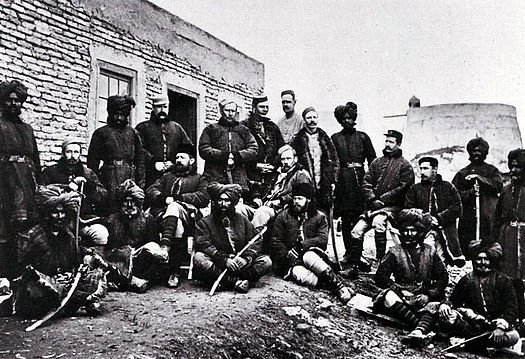
53rd Sikhs [3rd Royal Battalion] of the 12th Panjab Frontier Force
circa. 1879
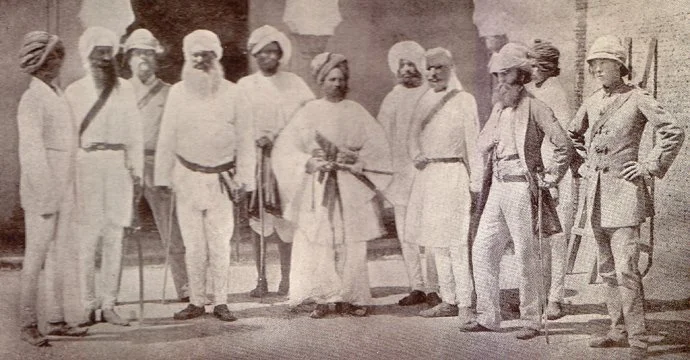
26th Punjabis [2nd Battalion] of the 15th Punjab Regiment
circa. 1859
Founded 14 Harh 552 / 28 June 2020.
Mission
Panjab is a geographic region in South Asia where eons of history has been rooted. The Lands of the 5 Rivers have seen empires rise, movements change the fabric of society and culture form at a tremendous and impactful scale. Defined geographically as lands east of the Suleiman Range, west of the Yamuna River, south of the Kashmir Foothills and north of the Bikaner Deserts, Panjab is a land of vast plains where the farmer prevails.
Now fractured politically through the divides of man, Panjab stands dissected as the Khyber Pakhtunkhwa, Panjab Province (West), Panjab State (East), Himachal Pradesh, Haryana and the culturally influenced Ganganagar and Hanumangarh districts of northern Bikaner (Rajasthan). With all this compounded by the existence of the Radcliffe Line, a defining symbol of treachery, bloodshed and the largest man-made refugee crisis in human history; entirely preventable. So prosperous is Panjab, that three capital regions exist within - New Delhi, Islamabad and Chandigarh. The latter two being planned cities in the 20th century.
Divisions have always existed. Yet state imperialism has led to the immense decline of the people’s history - that of the Panjabi Qaum or Panjabiyat. The forced agendas seeking to homogenize with the mainstream cultures has seen Panjab be rid of its astounding history. This project is seeking to avoid the continuation of such.
Utilizing the strength of the Panjabi brotherhood on both sides of the Radcliffe Line, Ranneeti was established with the mission to preserve in specific the military traditions and history of the people of Panjab. The specialization here being at a post-secondary grade, academic setting with scholarly intent of presenting history ethically - rid of detrimental dissections of Western interpretation.
The Beginnings.
Ranneeti began on Instagram in June 2020 as a modest attempt to detail and present Panjabi and Sikh military history in curated snippets for both the casual and interested reader. Initially beginning as curated for non-Sikh audiences, many Sikhs themselves began reaching out in earnest to continue knowledge sharing pursuits from The Curator of Ranneeti. This simple project has since expanded to cover all sorts of online media and in-person presentations, with The Curator having been hosted on numerous podcasts, in-person history seminars, article publishing, and more. The Ranneeti Online website seeks to even further push this pursuit of educational content for all, Panjabi, Sikh and non-Panjabi alike, from the indigenous Panjabi lens.
Why the emphasis on Shahmukhi?
While many Sikhi-Gurmat websites exist online, virtually none seek to bridge the gap between East and West Panjab. This is emphasized with the case of how easy it is to transliterate Gurmukhi into Shahmukhi to reach a brand new audience. The idea here is not to so much preach but rather educate. A whole segment of the Panjabiyat in West Panjab (Pakistan) know little to none of the indigenous faith of Pakistan, and by extension, local philosophies native to Panjab. The Curator of Ranneeti believes all the people of West Panjab have the right to know of their local beliefs, without any restrictions.
-
Anmol Singh Rode is the Founder and Curator of the Ranneeti platform. An avid researcher and historian, Anmol Singh has since completed a Bachelors of Environmental Studies and Minors Degree in History from York University (2022). He has since completed a B.A. in History from Trent University (2025).
Following his father’s field of work in studying Panjab during British colonial occupation (1849-1947), Anmol Singh has since specialized in the militarization of Panjab and aspects of Panjabi and Sikh soldiery in colonial warfare - with a particular scope on Panjabi participation in the World Wars (1914-1918; 1939-1945).
Paying attention to underrepresented historical narratives among the Sikh Nation, Anmol Singh upon the endeavour of establishing Ranneeti, has since become learned of Panjabi and Sikh History during the Misl or Confederacy Period post-Banda Singh Bahadur to the later establishment of the Sikh Empire (1716-1799), with specializations in the early creation period of the Misls (1723-1748), Sikh relations during the exploits of Faujdar Adina Beg Khan and Maratha General Raghunath Rao in Panjab (1734-1764) and the general interpretations of the Sarbat Khalsa Assemblies - along with having also studied the Revolution of Baba Gurbakhsh Singh Banda Bahadur (1708-1716).
Academically, Anmol Singh has studied East Asian (Chinese, Japanese and Korean) and Canadian History, of which he holds interests in further learning about. Due to the current lack of Panjabi and Sikh historical narratives particularly in Canadian universities and institutions, Anmol Singh has since been keen on presenting Panjabi/Sikh academic thought openly to both Panjabis indigenous to Panjab and the diaspora abroad. Anmol Singh advocates for dissections and interpretations of Sikh History (Gur-Itihaas) to be done through a healthy blend of both established Western scholarly lenses and the much-respected Gurmat; or traditional Sikh Doctrine. Through supplementing Gurmat as the primary dictator and coupling it with the modern mode of history, Anmol Singh has also advocated for this technique to be applied when seeking to decolonize Panjabi and Sikh History - being much effective in shedding both flawed and outdated British colonial and modern Brahministic narratives attempting to alter presentations of Sikh History. Anmol Singh believes that through open and easily-accessible dialogue, Sikhs particularly in the diaspora can have a deepened and stronger connection and understanding of their faith. As a Panjabi Nationalist, Anmol Singh has also made it a primary goal for West Panjabis and Pakistani Muslims left of the Radcliffe Line to easily learn and grasp Sikh concepts which are entrenched in understanding Panjab as a grander and true Nation. This can be seen through his constant use of the Shahmukhi script for West Panjabi readers, advocacy in the preservation of Panjabi language and history on both sides of the Radcliffe Line and fighting against imperialist narratives coming from New Delhi and Islamabad which heavily detriment the Panjabi identity.
Recognizing his maternal ancestry from the respected Village of Rode, the same village as the 14th Damdami Taksal Jathedar Sant Jarnail Singh Ji Khalsa Bhindranwale, Anmol Singh understands the importance of many Sikhs who view their Sikhi through the lens of a specific jathebandi or sampradya (faction and/or school of thought). Although he is not a direct adherent of the Sri Damdami Taksal Jatha, Anmol Singh holds the school of thought in high regard as proven firmly throughout the ages of Sikh History and seeks their interpretation whenever attempting to learn or further share Gurmat. Anmol Singh takes his religious influences from the works and understandings of Jathedar Sant Gurbachan Singh Bhindranwale, Bhai Sahib Bhai Randhir Singh, Giani Bhai Sant Singh Maskeen, Sant Baba Syed Prithipal Singh, Sant Kirpal Singh Rode (Taksal), Sant Baba Dal Singh Rode, Akali Baba Kaur Singh Nihang and Jathedar Akali Baba Raja Raj Singh Nihang. Anmol Singh derives his scholarly understandings from Bhai Sahib Bhai Vir Singh, Principal Jodh Singh, Bhai Kahn Singh Nabha, Dr. Ganda Singh, Prof. Teja Singh, Dr. Balwant Singh Dhillon and to lesser extents Mr. Max Arthur (Singh) Macauliffe, Dr. Kirpal Singh and Prof. Kashmira Singh. Anmol Singh does not regard all their works as infallible.
Anmol Singh Rode is a first-generation Canadian residing in Toronto, Ontario; on the 1923 Williams Treaty Indigenous Territories of the Anishnaabe, Mississaugas of Scugog, Haudenosaunee and Wendat First Nations of Tkaronto.